
AI is now present in the workplace. Also in HR, planning, and payroll preparation.
Employees use AI to write texts, summarize documents, analyze data, search for errors, or recognize patterns. Often this is done with the best intentions. People want to work faster. They want to correct less manually. They want to understand more quickly where something is going wrong.
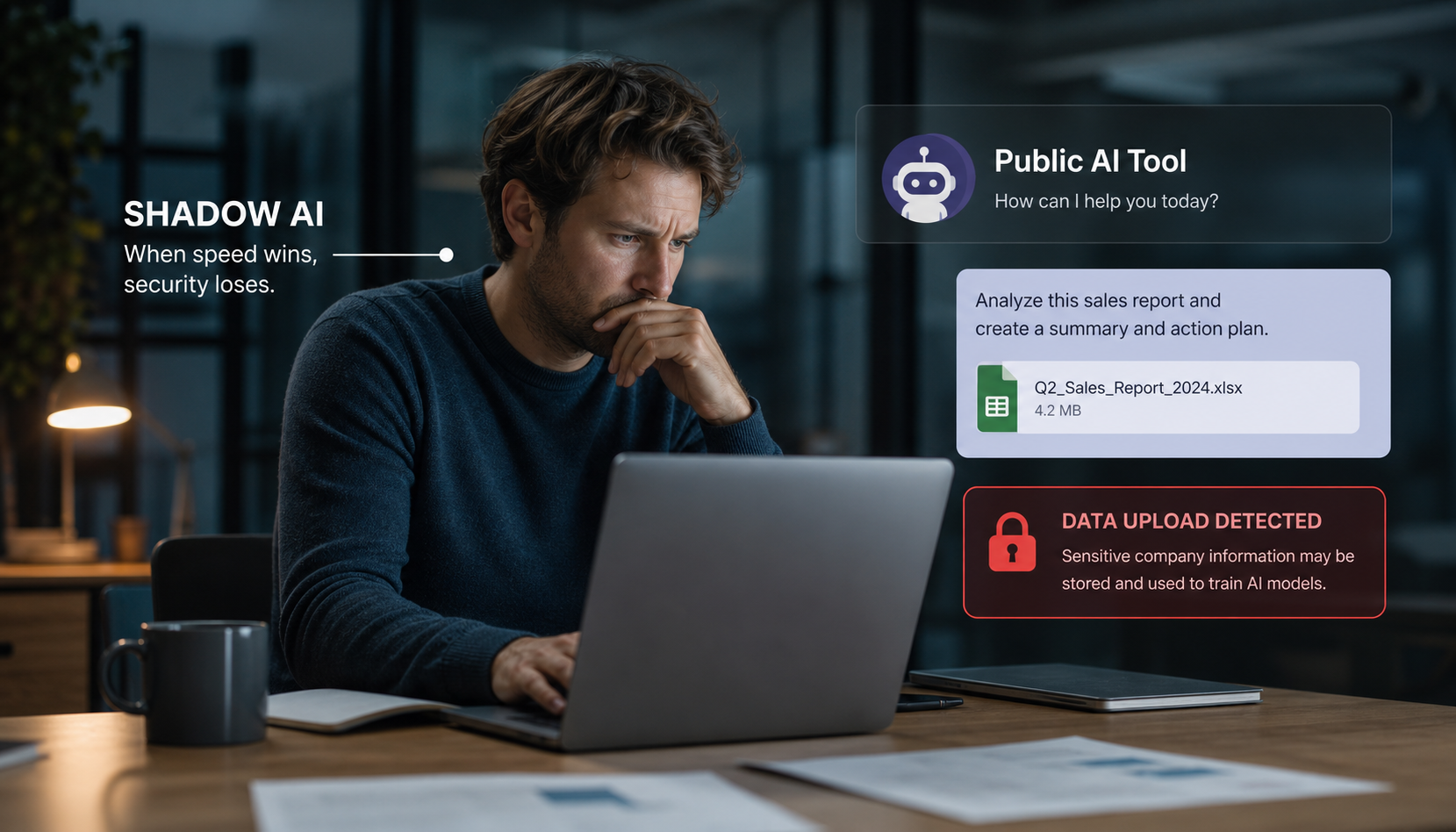
But it is precisely there that a new risk arises: shadow AI.
Shadow AI is the use of AI tools by employees or teams without formal approval, control, or governance from IT, security, or management. Think of a planner who loads an Excel file with employees, clients, projects, and availabilities into a public AI tool. Or an HR employee who has payroll data, absences, or internal rules summarized by a chatbot. Or a payroll team that has complex allowances or mobility reimbursements interpreted by a separate AI tool.
That seems efficient. Until you realize what data might be in there.
Names of employees.
Hours and performance.
Absences.
Mobility.
Allowances.
Internal salary agreements.
Project information.
Customer data.
Recruitment locations.
Certificates.
Costs and margins.
The problem is not that HR or payroll wants to use AI. The problem is that sensitive data ends up outside the controlled business flow.
Shadow AI is not a hype. It is an alarm signal.
According to Gartner, 69% of the surveyed organizations suspect or know that employees are using prohibited public GenAI tools. Gartner also warns of risks such as IP loss, data exposure, and increased security risks. Gartner also predicts that by 2030, more than 40% of enterprises will experience security or compliance incidents linked to unauthorized shadow AI.
Gartner also identified shadow AI as a top concern for risk leaders in 2025.
But for HR, pre-payroll, and operations, the main question is not just:
What AI tools are our employees using?
The better question is:
Why do they need those separate AI tools?
Because shadow AI rarely arises from bad intentions. It arises where processes are too slow, too fragmented, or too manual. Where people have to copy data. Where Excel remains the emergency bridge. Where exceptions only become visible at the end of the month. Where planning, registration, approval, rules, and payroll preparation are not on the same data line.
In other words: shadow AI is often not an IT problem. It is a symptom of operational friction.
Why this is particularly relevant for HR and pre-payroll.
HR and pre-payroll work with sensitive and complex data. It's not just about "hours". It's about the interpretation of those hours.
- Was someone scheduled or actually present?
- Was there mobility?
- Was there a deviation?
- Was there a surcharge applicable?
- Is the performance approved?
- Which regime, which collective labor agreement, or which internal rule applies?
- Which wage code should ultimately go to the payroll service provider?
Those questions are rarely solved by one system alone. In many companies, the information is spread across planning, time registration, ERP, HR systems, emails, Excel files, and manual checks.
That's where pressure arises. And where pressure arises, people look for shortcuts.
Today, that shortcut is increasingly AI.
Use case 1: payroll uses AI to understand exceptions faster.
Payroll preparation is often the endpoint of all operational deviations. What was not correctly recorded in planning, registration, and approval ultimately ends up with HR or pre-payroll.
Just before the payroll closing, everything needs to be clear quickly.
Which hours are correct?
Which mobility counts?
Which surcharge is applicable?
Which absence affects the calculation?
Which exception still needs to be approved?
Which wage code applies to this situation?
If that information is spread out, AI becomes attractive. An employee copies a situation to an AI tool and asks:
"Which wage code should I use?"
"How should I interpret this mobility allowance?"
"What surcharge applies to this performance?"
"Create a formula for this exception."
"Check this Excel with hours and bonuses."
That seems harmless. But payroll must not take risks.
An AI tool can provide convincing answers and still be wrong. Especially when it comes to collective labor agreement rules, internal agreements, mobility, bonuses, overtime, shifts, night work, weekend work, or exceptions. A wrong answer leads not only to corrections. It leads to discussions, frustration, and loss of trust among employees.
With VIRO that complexity is not interpreted ad hoc by AI. VIRO applies rules centrally, verifiably, and reproducibly. Raw registrations are automatically processed into correct wage codes and payroll-ready output. Deviations are visible before the payroll closing, not after.
Flo can additionally support as an AI co-pilot. For example, by signaling deviations, identifying patterns, or answering questions based on validated data. But the foundation remains: rules, calculations, and validations must be traceable.
AI may support payroll. Not replace it with loose interpretation without control.
Use case 2: planning seeks AI because rescheduling requires too much manual work
Many payroll problems do not arise in payroll. They arise earlier.
In planning.
On the site.
At registration.
With late changes.
In cases of illness, absences, extra assignments, or changed shifts.
A planner, for example, learns on Thursday evening that an employee is sick, a site is shifting, and a client is requesting extra capacity. The schedule for Friday must be correct again.
If the planning is in Excel or in a limited visual planning board, the pressure quickly becomes high.. The planner must take into account availabilities, skills, certificates, teams, equipment, locations, travel times, and internal rules..
The temptation is great to take an export and ask AI:
"Make a better schedule from this."
"Find conflicts in this schedule."
"Distribute these employees over these sites."
"Reschedule tomorrow based on availability and skills."
But that export often contains sensitive data: employee names, client data, site addresses, certificates, availabilities, schedules, and sometimes also project information.
Moreover, AI can make a proposal that is operationally incorrect: someone without a valid certificate, a double booking, incorrect team allocation, an unavailable employee, or an unrealistic combination of tasks.
Therefore, planning should not be optimized outside the process, but within the process.
With SOLUTIO planning works based on operational reality. Not just based on blocks in a calendar, but based on constraints such as availabilities, absences, skills, certificates, equipment, capacity, and rules. When changes occur, it can be rescheduled faster and more realistically, without sensitive data needing to be copied to separate tools.
The mobile registration brings back the reality of the workplace to the back office: hours, mobility, materials, photos, checklists, digital work orders, and deviations.
Thus, planning becomes not a standalone schedule, but the beginning of a reliable data stream towards approval, pre-payroll, and post-calculation.
Use case 3: management wants to see patterns in costs, overtime, and deviations more quickly.
Management also feels the pressure.
Overtime is increasing.
Mobility costs are rising.
Projects are becoming more expensive than expected.
Post-calculation comes too late.
Teams are deployed differently than planned.
Deviations only become visible when the month is almost closed.
The question is logical:
"Where are we losing money?"
When the right reporting is lacking, managers quickly resort to exports. Data from planning, ERP, time registration, HR, payroll, and finance is compiled in Excel and then analyzed with AI.
"Where are the most deviations?"
"Which teams have the most overtime?"
"Which projects deviate from the plan?"
"Why is this site over budget?"
"Summarize these cost differences for management."
This can provide insights in the short term. But again, risk arises. Project costs, personnel data, customer information, rates, margins, and internal financial data can end up outside the controlled environment.
Moreover, the output is only as reliable as the input. AI on top of incomplete or incorrect data does not speed up decisions. It speeds up wrong conclusions.
GO-VIRTUAL approaches this differently. By better connecting planning, mobile registration, approval, VIRO processing, and ERP post-calculation, a more reliable data line is created. This makes deviations visible earlier and AI can help analyze based on validated information.
Not trying to explain afterwards why the margin is gone. But seeing faster where the deviation occurs.
The real solution: no AI ban, but a better flow
Companies cannot solve shadow AI by simply banning AI. Then the usage shifts to private accounts, browser tools, or standalone applications. Employees continue to seek speed, especially when the pressure is high.
The better approach is: offer a controlled alternative.
This starts with the operational flow.
At GO-VIRTUAL, we see that flow as one chain:
master data → planning → mobile registration → approval → pre-payroll → payroll-ready output → ERP post-calculation
When that chain breaks, manual work arises.
When manual work increases, Excel dependency grows.
When Excel dependency grows, employees look for shortcuts.
And today those shortcuts are often AI tools.
Therefore, AI should not be separate from the process. AI should be integrated into a controlled data flow.
What SOLUTIO, VIRO, and Flo mean in this context
SOLUTIO provides realistic planning and quick rescheduling based on availability, absences, skills, certificates, materials, capacity, and rules. The solution helps planners respond more quickly to changes without losing control. Not by exporting data to separate tools, but by bringing planning, resources, and operational constraints into one flow.
The mobile registration ensures that the reality of the workplace is accurately reflected back to the back office. Hours, mobility, materials, photos, checklists, work orders, and deviations are not gathered afterwards, but are structurally recorded.
VIRO processes those raw registrations into correct pre-payroll output. Hours, allowances, mobility, reimbursements, absences, and exceptions are applied according to collective labor agreements and internal company rules. Not in Excel. Not based on gut feeling. Not through loose interpretation. But through a reproducible rule engine.
Flo can then assist as an AI co-pilot to gain insights more quickly. Think of detecting anomalies, naming trends, answering questions, or explaining deviations. But always on top of controlled data, with clear rights, traceability, and human validation where necessary.
That is the difference between shadow AI and controlled operations AI.

From risk to competitive advantage
Shadow AI shows where companies feel pressure today. It exposes where processes are too slow. Where data does not flow reliably. Where employees seek their own solutions because the official flow does not help them.
That does not have to remain a threat. It can also become a lever.
Whoever addresses the causes of shadow AI wins on multiple fronts:
- less manual work
- fewer error-prone Excel exports
- faster rescheduling
- better registrations
- fewer payroll corrections
- more control over exceptions
- faster detection of deviations
- fewer discussions about hours, mobility, and allowances
- better post-calculation
- more trust among employees
The message is therefore not: do not use AI.
The message is: use AI where it belongs.
Within a reliable flow.
On validated data.
With clear rules.
With control, logging, and traceability.
And with human validation where decisions impact people, money, or compliance.
Conclusion
Shadow AI does not start with IT. It starts where planning, registration, HR, and payroll preparation contain too many manual intermediate steps.
When employees throw sensitive data into loose AI tools, they usually do not do so out of unwillingness. They do it because they want to work faster than their systems allow.
GO-VIRTUAL helps companies to turn that reflex into controlled automation.
With SOLUTIO, planning becomes more realistic and registration more reliable. With VIRO, hours, mobility, exceptions, and wage codes are processed correctly. With Flo, AI can safely support within a traceable data flow.
This way, AI becomes not a risk alongside the process, but a controlled co-pilot in the flow from planning to payroll-ready output.
Sources
Gartner, "Gartner Identifies Critical GenAI Blind Spots That CIOs Must Urgently Address", November 19, 2025
This Gartner publication refers to a survey of 302 cybersecurity leaders, conducted between March and May 2025. It shows that 69% of organizations suspect or have evidence that employees are using prohibited public GenAI tools. Gartner also predicts that by 2030, more than 40% of enterprises will experience security or compliance incidents linked to unauthorized shadow AI.
Gartner, "Emerging Risk Deep Dive: Shadow AI", July 11, 2025
This Gartner report page identifies shadow AI as a current concern for risk leaders and discusses why organizations need to understand the causes, consequences, and possible mitigation strategies of shadow AI.
Shadow AI in HR is the use of AI tools by employees without formal approval or oversight from the organization. This occurs, for example, when HR, payroll, or scheduling data is copied into a public AI tool to interpret rules faster, search for discrepancies, or create reports. The risk is that sensitive personnel data ends up outside the controlled corporate environment.
Payroll preparation works with sensitive and complex data: hours, absences, mobility, allowances, reimbursements, exceptions, and collective labor agreement rules. If that information is processed in separate AI tools, it can lead to data risks, misinterpretations, incorrect payroll preparation, and disputes with employees. Payroll requires traceable, reproducible, and validated calculations.
Usually not out of unwillingness, but because they want to work faster. When planning, registration, HR, and pre-payroll do not align well, manual work arises. Employees then look for shortcuts to analyze Excel files, find patterns, understand exceptions, or create reports faster. Shadow AI is often a signal that the underlying flow is too slow or too fragmented.
GO-VIRTUAL helps companies address the causes of shadow AI. SOLUTIO provides realistic planning, quick rescheduling, and mobile registration. VIRO processes hours, mobility, allowances, and exceptions into correct payroll-ready output according to collective agreements and internal rules. Flo can support as an AI co-pilot on controlled data, with traceability and human validation where needed.
No. A total ban usually does not solve the problem. Employees will continue to look for faster ways to do their work. The better approach is to integrate AI in a controlled manner into a reliable data flow. This way, sensitive data remains within the right flow, and AI can safely assist in anomaly detection, pattern recognition, reporting, and explanations for deviations.